CASCADE GROUNDWATER ALLIANCE FREQUENTLY ASKED QUESTIONS
Benefits of the Groundwater system
How does switching from Bull Run to CGA benefit District customers?
Long-term Value: Studies show the cost to produce groundwater will be significantly less than purchasing the same amount of water from Portland in the future. By partnering with the City of Gresham to build our own groundwater system, we have a greater ability to manage future water supply costs and keep water rates affordable.
Local Ownership and Control: Local ownership of water resources gives us control over water supply decisions. Decisions about water rates, system investments and water policy will be made by local decision-makers who are committed to our community.
Resiliency and Emergency Preparedness: By using groundwater, customers benefit from a protected water supply carried through earthquake resistant pipes and reduced reliance on a single regional supply. This makes us better prepared to withstand and recover faster from earthquakes, severe storms, floods, fires, droughts, and other emergencies. The expanded groundwater system is designed to provide a reliable supply of safe, clean water to meet the current and projected future daily demands for Gresham and Rockwood Water customers.
Water Quality
Where does the water come from?
The Sand and Gravel Aquifer used as CGA’s groundwater source is the deepest aquifer in the Portland Basin. It is naturally protected from human‐caused contamination by two deep layers of clay and silt. In addition, groundwater for the Alliance is pulled from 700-1400 feet below the ground, which makes surface-level contamination unlikely
Do other local water systems provide groundwater to their customers?
Over 1 million people in the Portland Basin drink groundwater, including Fairview, Milwaukie, Portland, Troutdale, and Wood Village. See Regional Groundwater Source Providers map here for more information. Groundwater is commonly used and supplies 35% of the drinking water in the United States according to the US Geological Survey.
How is the water treated and is it safe?
Our groundwater is pumped from the aquifer through a filtration system to remove naturally occurring iron and manganese which can cause discoloration dark staining of fixtures and other surfaces. A small amount of chlorine is added to oxidize iron and manganese as part of the filtration process, disinfect the water and maintain a protective chlorine residual throughout the distribution system.
We test for more than 300 regulated and unregulated substances in the groundwater as required by the EPA & OHA. Our water meets all state and federal drinking water standards.
How often is CGA water tested for safety and are those results available?
CGA groundwater is sampled at frequencies required by the EPA & OHA. All sample results are below Maximum Contaminant Levels, and most regulated contaminates are non-detectable. Sample results are available to the public on Oregon Health Authority’s website: Drinking Water Data Online | Data Online | Oregon Drinking Water Services.
Will water taste/odor and spotting get better?
The District is continuing to optimize treatment by reducing chlorine residuals to the lowest level as practical, while maintaining high-quality water. Customers may notice improvement as the system is optimized and water moves regularly through household plumbing. Individual sensitivity to chlorine taste and odor varies, however, and some customers may continue to notice it.
Spotting and scaling is caused by natural minerals in the groundwater, those characteristics are inherent to our water source and will not change with the treatment process.
Taste and Odor
What causes the chlorine taste and odor in the water?
A small amount of chlorine is added to our groundwater to ensure water quality is maintained throughout the system. Chlorine is commonly used by public water systems and is regulated under state and federal drinking-water standards. Some customers may notice a chlorine taste or odor even when the concentration is low and within applicable standards.
Why couldn’t I smell chlorine before?
Portland adds chlorine and then ammonia to form chloramine, a longer-lasting disinfectant that generally has a less noticeable chlorine odor.
CGA uses free chlorine without adding ammonia. Free chlorine can be more noticeable to some customers, even at relatively low concentrations. A noticeable chlorine odor does not indicate that the concentration is unusually high or unsafe.
Why do we use free chlorine instead of chloramine?
Chloramine is often used in very large water systems because it is more stable and longer lasting than free chlorine, allowing a disinfectant residual to be maintained over greater distances in the distribution system. The CGA system is smaller and its groundwater contains relatively low levels of organic material. This allows CGA to maintain the necessary disinfectant residual throughout the system using free chlorine without adding ammonia. The District continually monitors chlorine levels and adjusts treatment as needed to protect water quality.
Click here to see a map of Suppliers Using Chloramine vs. Free Chlorine
Water Hardness and Spotting
What causes the spotting on dishes, vehicles, and other hard surfaces?
In comparison to surface water, groundwater typically contains higher levels of minerals that cause “hardness”. White spots are usually caused by mineral deposits (primarily calcium, magnesium and silica) left behind when water dries.
There are commercially available cleaning products that are sold to address mineral build up on appliances and countertops. Using a rinse aid in your dishwasher can help reduce spotting on dishes and glassware. It is also important to dry surfaces with a towel or microfiber cloth rather than letter them air dry.
How hard is CGA water compared to Portland Water?
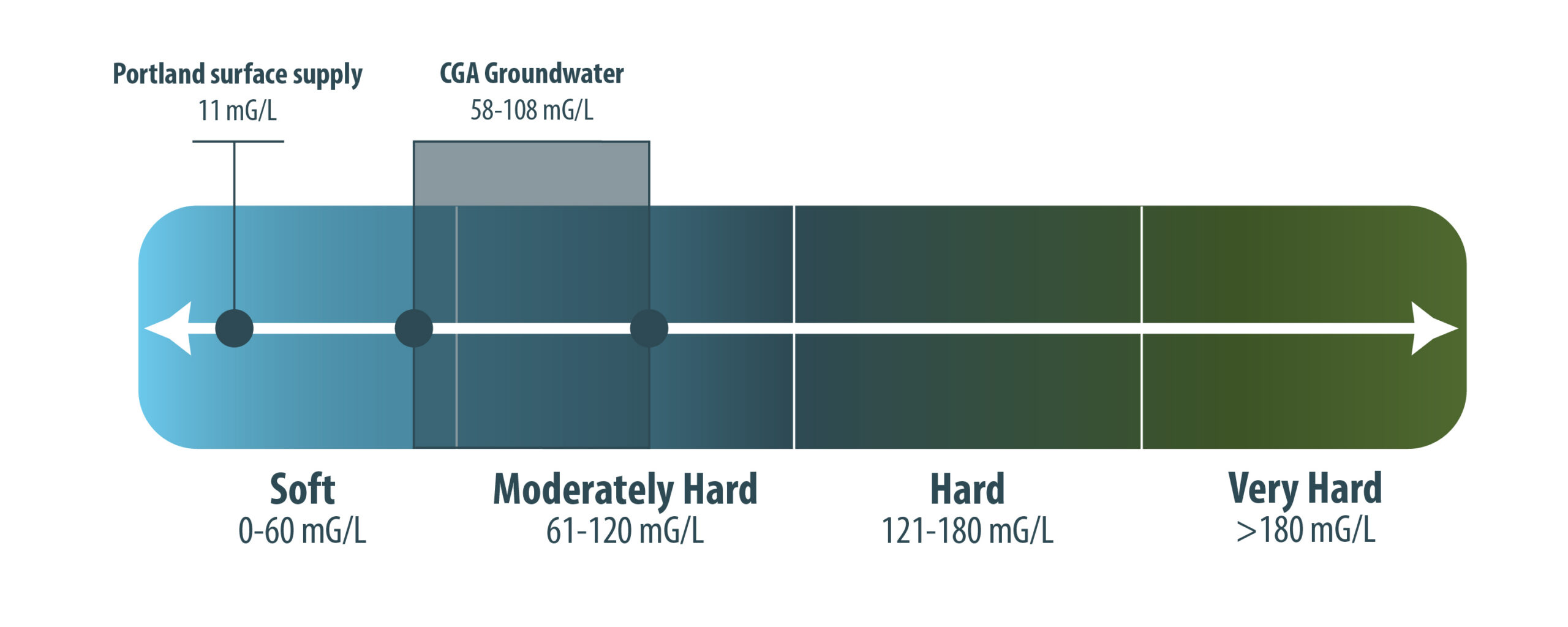
Water hardness is measured in milligrams per liter as calcium carbonate. The U.S. Geological Survey uses the following general classifications:
0–60 mg/L: soft
61–120 mg/L: moderately hard
121–180 mg/L: hard
More than 180 mg/L: very hard
CGA groundwater generally ranges from approximately 58 to 108 mg/L and is therefore classified as mostly moderately hard. Bull Run water is generally below 10 mg/L and is classified as soft.
We do not expect the current water hardness levels to significantly affect normal appliance operation. However, because groundwater contains more naturally occurring minerals than surface water, customers may notice more mineral scale buildup over time on appliances, fixtures, and water heaters. Regular cleaning and use of descaling products can help reduce buildup.
Finances and Cost
How does the new groundwater system help manage future costs for Rockwood customers?
The filtration project associated with our previous water system was originally estimated to cost $500 million in 2017 and is now expected to cost more than $2.6 billion dollars to complete. Like other major utilities, these infrastructure costs will be passed onto customers in the form of increased service fees. By partnering to build our own groundwater system, keeping water rates more affordable than if we have stayed on our previous water system.
District studies project that locally produced groundwater will provide a lower long-term water supply cost than continuing to purchase the same volume of water from Portland. The CGA partnership also gives Rockwood and Gresham greater local control over operating decisions, infrastructure investments, and long-term planning.
While the Cascade Groundwater Alliance’s water system will not eliminate all future water costs or challenges in Rockwood, it does significantly improve the District’s ability to manage those costs and risks locally, transparently, and strategically.